

Can Your Mattress Cause Shoulder or Hip Pain?

Updated: 4 days ago

If your shoulder or hip hurts when you wake up, your mattress may be contributing—but it is not automatically the cause. Side sleepers place more direct pressure on these prominent areas, and the wrong combination of surface firmness, comfort-layer depth, and underlying support can make that pressure harder to tolerate.
A mattress can also hold your body in an uncomfortable position when it is too soft, uneven, or worn out. At the same time, shoulder and hip pain can come from injuries, arthritis, bursitis, tendon problems, the spine, and other medical conditions that a mattress cannot diagnose or treat.
The useful question is not simply, “Is my mattress causing pain?” It is: “What evidence connects the pain to my sleep surface, and what else needs to be ruled out?”
Professor Goodsleep is a mattress expert, not a physician. This article provides general education and is not a medical diagnosis.
The Quick Answer
Your mattress becomes a reasonable suspect when:
The discomfort is strongest after sleeping and improves after you get moving
The pain is concentrated on the side you normally sleep on
You sleep better and wake with less pain on another suitable mattress
Pressure builds beneath your shoulder or hip during a side-sleeping test
The mattress has a visible low spot, uneven support, or badly softened comfort layers
Rotating the mattress provides noticeable but temporary relief
The problem began after changing mattresses or as an older mattress deteriorated
Those clues show association, not proof. Persistent, severe, worsening, or injury-related pain deserves medical evaluation.
Shopping for a mattress and comparing cushioning with support? Build a shortlist with the free mattress consultation: 3–5 mattress recommendations instantly, with no email required.
Why Side Sleepers Feel More Shoulder and Hip Pressure
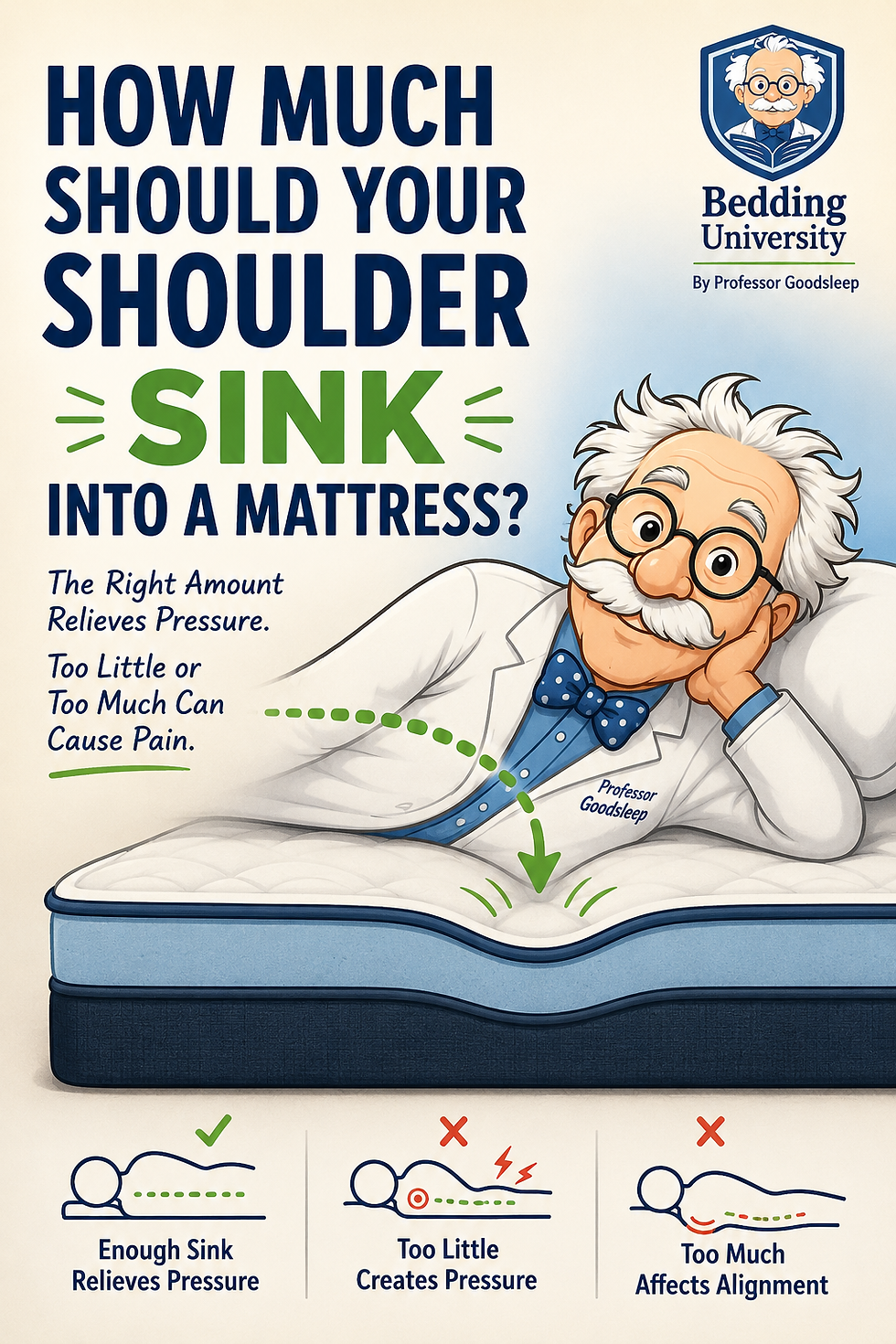
When you sleep on your side, your shoulder and hip form the widest contact points between your body and the mattress. The sleep surface must allow those areas to settle enough to spread pressure over a larger area.
At the same time, the mattress must support the waist, ribs, and pelvis so the spine is not forced into a pronounced sideways curve. This creates a balancing act:
Too little cushioning can concentrate pressure beneath the shoulder and outer hip.
Too much uncontrolled sink can let the torso or pelvis collapse and create an awkward sleeping position.
Uneven wear can produce both problems in different parts of the same mattress.
The goal is not maximum softness. It is enough pressure relief for your body shape, combined with stable support underneath.

Pressure Relief and Support Are Not the Same
Pressure relief describes how well the mattress spreads your weight and cushions prominent areas. Support describes how well the mattress keeps heavier sections of the body from sinking farther than the rest.
A mattress can feel firm yet provide excellent support and poor pressure relief. Another mattress can feel plush on top but still have a strong, supportive core. This is why “firm equals supportive” is one of the most misleading ideas in mattress shopping.

Research on mattresses and pain is much more limited than mattress advertising suggests. A health-technology review in the NCBI Bookshelf found insufficient research supporting broad medical claims for particular mattresses. A systematic review indexed by PubMed examined mattress design, sleep quality, pain, and spinal alignment, but most clinical evidence centers on back pain—not proving that one mattress type treats shoulder or hip conditions.
A mattress should therefore be evaluated as part of the sleep environment, not prescribed as medical treatment.
How a Mattress That Is Too Firm May Affect You
A surface can be too firm for a particular sleeper even when it is well made.
At the shoulder
If the shoulder cannot settle into the comfort layers, pressure may build beneath the upper arm and shoulder joint. Broad-shouldered side sleepers often need more available depth at the shoulder than people with narrower frames.
Common clues include:
Shoulder discomfort that develops after several minutes on your side
An urge to roll backward to get off the shoulder
Waking with the lower arm tingling or numb
A gap beneath the waist because the shoulder is holding the torso too high
Feeling comfortable on your back but uncomfortable on your side
If tingling or numbness is part of the problem, read Why Do My Arms Go Numb While Sleeping?. That symptom has possible nerve-related and medical causes that go beyond mattress firmness.
At the hip
A firm surface can create concentrated pressure over the outer hip. However, pain while lying on the affected side can also occur with medical problems such as hip bursitis. The American Academy of Orthopaedic Surgeons notes that hip bursitis pain is often worse at night and while lying on the painful hip.
That overlap is exactly why “the mattress did it” should not be the automatic conclusion.
How a Mattress That Is Too Soft May Affect You
Softness can reduce surface pressure, but excessive or uneven sink creates different problems.
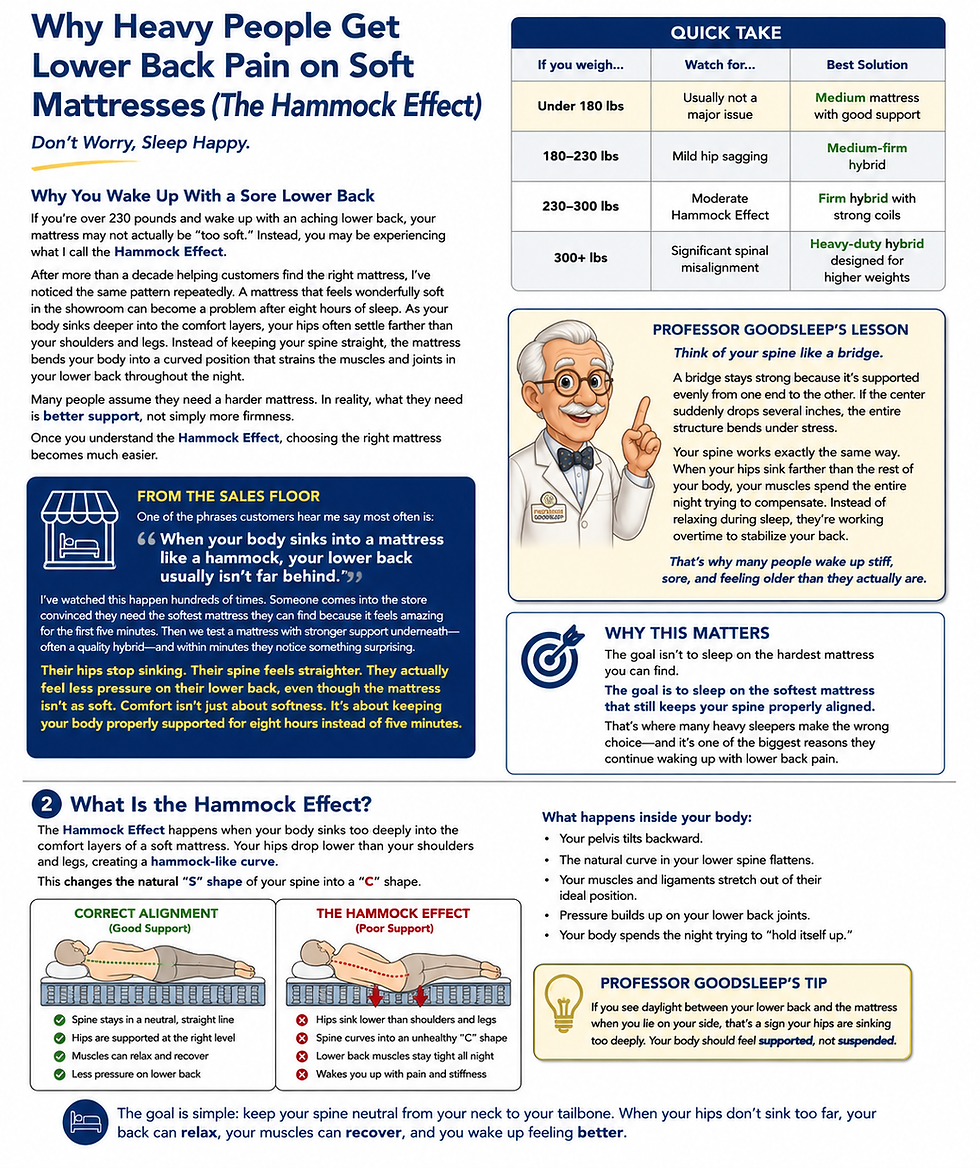
The pelvis may settle more deeply than the ribs and legs.
The waist may lose support.
The torso may rotate forward or backward.
The upper shoulder may collapse toward the lower shoulder.
Changing positions may require more effort.
A worn depression may repeatedly pull you into the same spot.
A soft mattress can still be supportive when its comfort layers compress gradually over a stable core. The problem is not softness itself; it is uncontrolled or uneven sink for the sleeper using it.
A Worn Mattress Can Feel Firm and Soft at the Same Time
This sounds contradictory, but it is common. The upper padding may be compressed so the shoulder encounters a harder-feeling surface, while the support layers underneath have softened enough to let the pelvis sag.
Age alone does not prove failure. Look for performance changes:
Body impressions or a hammock effect
A low spot that returns after rotation
Edges that collapse more than they once did
Increased difficulty changing positions
Pressure in areas that were previously comfortable
Better sleep on another suitable bed
If you see a lasting depression, use the diagnostic steps in Mattress Sagging: When Is It Time to Replace Your Mattress?.
Your Pillow Can Change Shoulder Pressure
Pillow height affects the position of the head and neck, but it also changes how the upper body rests on the shoulder.
A side sleeper generally needs the pillow to fill the space remaining after the shoulder sinks into the mattress. That means the correct height changes with:
Shoulder width
Body weight
Mattress firmness
Comfort-layer depth
Pillow compression
A pillow that is too high can push the head away from the mattress and load the neck and upper shoulder. A pillow that is too low can let the head drop and encourage the body to roll farther onto the shoulder.
There is no universal pillow height. Reassess the pillow whenever you change mattresses because the shoulder may sink a different amount.

Shoulder Pain and Hip Pain Are Not Always the Same Problem
Treating both symptoms as a single “pressure-point problem” can miss important differences.
Shoulder discomfort may be influenced by:
Shoulder width and side-sleeping position
Pillow height and neck position
Sleeping with the lower arm trapped beneath the body
Mattress firmness at the upper torso
An existing shoulder or neck condition
Hip discomfort may be influenced by:
Pelvic width and prominence of the outer hip
Mattress cushioning at the hip
Excessive pelvic sink or inadequate waist support
A worn low spot
An existing hip, back, or soft-tissue condition
Pain location is useful information, but it is not a diagnosis.
My Shoulder-Pain Experience
In my late 30s, I developed shoulder pain that lasted about six months. I blamed weightlifting and then wondered whether I was simply getting older. When the pain moved from one shoulder to the other, I finally examined how I was sleeping.
My mattress was more than ten years old and no longer provided the pressure relief my broad shoulders needed. I returned to mattress stores, tested beds in my normal side-sleeping position, and eventually chose a plush hybrid that allowed my shoulder to settle while still supporting my side and hip. My shoulder pain faded over approximately a month.
That experience changed the questions I ask customers. I now pay close attention to shoulder width, body weight, sleeping position, tingling, numbness, and what happens after someone remains on a mattress for more than a minute.
The complete story—including the morning I could not roll off my dead arm to reach the alarm before Mrs. Goodsleep whacked me with a pillow—is in my arm-numbness guide.
My experience does not prove that every case of shoulder pain comes from a mattress. It shows why the sleep surface belongs in the investigation when the pattern fits.
A Seven-Night Mattress Check
One night can be misleading. Use a short written record to identify a pattern.
Each morning, note:
Which shoulder or hip hurts
Your main sleeping position
Whether you woke during the night
Whether you noticed numbness or tingling
Pain intensity when you first got up
How the discomfort changed during the first hour
Whether you rotated the mattress, changed pillows, or slept elsewhere
Do not make several changes at once. If you replace the pillow, add a topper, rotate the mattress, and change sleeping positions on the same night, you will not know which change mattered.
What to Check Before Buying a New Mattress
Inspect the foundation
A bowed slat, excessive gap, missing center support, or damaged foundation can make the mattress feel uneven. Correct the support underneath before judging the mattress.
Rotate only when permitted
A head-to-foot rotation can move your body away from a worn area. A clear but temporary improvement suggests uneven wear. Do not flip a one-sided mattress.
Remove the topper during testing
A topper can hide the surface temporarily, but it usually follows the same depression underneath. Test the mattress by itself before deciding what has failed.
Compare another bed
If possible, sleep several nights on another appropriate mattress. Consistent improvement is more meaningful than one unusually good hotel night.
Reassess the pillow
A mattress change alters how deeply your shoulder sinks, which can make a previously suitable pillow too high or too low.
How to Test a Mattress for Shoulder and Hip Pressure
Spend the majority of the showroom test in your normal sleeping position.
Bring your usual pillow or approximate its height.
Lie on the side that normally hurts.
Remain there for at least ten minutes.
Notice whether pressure steadily builds at the shoulder or hip.
Check whether the waist feels supported.
Ask whether the spine appears reasonably level from behind.
Roll to the other side and evaluate ease of movement.
Compare at least three different firmness levels.
Do not let the salesperson rush the test. A mattress that feels luxurious for thirty seconds can become uncomfortable after the comfort layers settle.
My ten-minute mattress-testing guide provides a repeatable process.
Which Mattress Materials Relieve Pressure Best?
No material wins for every sleeper.
Memory foam
Memory foam can contour closely and distribute pressure well. Its slower response may feel difficult for people who change positions frequently, and quality varies greatly.
Latex
Latex generally feels more responsive and buoyant. Softer Talalay latex can provide substantial cushioning without the slow sink of memory foam, while firmer or thinner latex may feel too resistant for some side sleepers.
Hybrids
A hybrid can combine pressure-relieving comfort layers with a stable coil system. The label “hybrid” does not guarantee comfort; the thickness and quality of the upper layers still determine what the shoulder and hip feel.
Traditional innersprings
An innerspring with minimal padding may create more concentrated pressure. A well-upholstered innerspring can still work when its comfort layers match the sleeper.
For broader guidance, see Best Mattress for Side Sleepers.
Can a Mattress Topper Help?
A topper may help when the mattress is structurally sound but slightly too firm. It adds cushioning and can change the surface feel.
A topper is unlikely to solve:
A deep sag or body impression
A weak or damaged foundation
A mattress that is already too soft
Poor underlying support
A medical cause of pain
Treat a topper as a comfort adjustment, not a repair or medical treatment.
When to Seek Medical Care
Shoulder and hip pain have many possible causes. The mattress is not an adequate explanation when symptoms are severe, persistent, worsening, or accompanied by loss of function.
The AAOS guidance on shoulder pain recommends prompt medical care after an acute injury causing intense pain and evaluation when symptoms persist.
Seek urgent medical care for hip pain after an injury when you cannot bear weight, the joint appears deformed, or there is intense pain or sudden swelling. These are among the warning signs listed by the Mayo Clinic.
Arrange a medical evaluation when pain:
Persists despite reasonable sleep-position changes
Continues or worsens during the day
Limits movement or normal activities
Is associated with weakness, numbness, swelling, redness, or fever
Began after an injury
Repeatedly interrupts sleep
You can evaluate your mattress and seek medical care at the same time. One does not exclude the other.
Frequently Asked Questions
Can a mattress cause shoulder and hip pain?
A mattress can contribute by creating concentrated pressure, excessive sink, poor alignment, or uneven support. It is one possible factor, not the only possible cause.
Can a firm mattress cause shoulder pain?
Yes, a surface that does not allow enough shoulder immersion can create uncomfortable pressure for some side sleepers. Firmness is relative to body weight, shoulder width, sleeping position, and mattress construction.
Can a mattress that is too soft cause hip pain?
A mattress that allows the pelvis to sink excessively or unevenly can create an uncomfortable position. Hip pain can also come from medical conditions, so softness should not automatically be blamed.
What mattress firmness is best for shoulder and hip pain?
There is no universal number. The right mattress cushions the shoulder and hip while supporting the waist and pelvis. A person's body weight, proportions, sleeping position, and comfort preference all matter.
Will a topper fix shoulder or hip pain?
A topper may improve cushioning on a sound mattress that is slightly too firm. It will not repair sagging, correct a weak foundation, or treat an underlying medical problem.
How can I tell whether my mattress is contributing?
Look for a repeatable pattern: pain strongest after sleep, pressure building in your normal position, improvement elsewhere, temporary relief after rotation, or obvious mattress wear. No single clue proves causation.
The Bottom Line
Your mattress can contribute to shoulder and hip pain when it creates too much surface pressure, allows uncontrolled sink, or has worn unevenly. But pain is not a mattress diagnosis.
Use patterns instead of assumptions. Check the mattress, foundation, pillow, sleeping position, and how you feel on another bed. If the symptoms are persistent, severe, worsening, injury-related, or associated with weakness or loss of function, involve a healthcare professional.
The right mattress does not have to be the softest or firmest. It needs to give your shoulder and hip enough room while maintaining stable support for the rest of your body.
If you are also comparing mattresses for your everyday comfort preferences, use the free mattress consultation to narrow your shortlist.
Bedding University is reader-supported. When you buy through links on our site, we may earn an affiliate commission at no extra cost to you.
Don't worry, sleep happy.
Professor Goodsleep


Comments